
Alternate-Day Statin Dosing Calculator
How This Calculator Works
Based on clinical studies, alternate-day dosing of long-acting statins (atorvastatin and rosuvastatin) typically achieves 92-95% of the LDL reduction from daily dosing.
Your Input
Your Results
Enter your data to see results
Estimated LDL reduction with alternate-day dosing
Important: Alternate-day dosing works best with atorvastatin and rosuvastatin. It typically achieves 92-95% of the LDL reduction from daily dosing. For patients with high heart risk, LDL goals are often <70 mg/dL.
What if you could cut your statin dose in half - and still keep your LDL cholesterol under control - but with far fewer muscle aches and pains? For millions of people who can’t tolerate daily statins, alternate-day statin dosing isn’t science fiction. It’s a real, evidence-backed option that’s quietly helping patients get back to normal life.
Why Alternate-Day Dosing Exists
About 1 in 7 people who take statins stop because of muscle pain, weakness, or cramps. That’s statin-associated muscle symptoms - or SAMS. It’s not always serious, but it’s enough to make people quit their meds. And when they do, their heart risk goes up. Doctors noticed something interesting: some statins, like atorvastatin and rosuvastatin, stick around in the body for a long time. Atorvastatin lasts 14 to 30 hours. Rosuvastatin? Around 19 hours. That’s long enough to keep working even if you skip a day. So why not give the drug every other day? That way, you’re still getting the cholesterol-lowering effect - but with fewer daily exposures, which might mean fewer side effects. This isn’t a new idea. Back in 2012, a small study in India showed that people taking atorvastatin 20 mg every other day had nearly the same LDL reduction as those taking it daily. The difference? Almost none. And the muscle pain? Much lower.How Effective Is It for Lowering LDL?
The numbers don’t lie. A 2017 review of 11 studies - involving over 1,000 patients - found that alternate-day dosing of atorvastatin or rosuvastatin lowered LDL by 92% to 95% of what daily dosing achieved. That means if daily statins drop your LDL by 50%, every-other-day dosing might drop it by 46% to 48%. In one study, 38 people with high cholesterol took 20 mg of atorvastatin daily for 12 weeks. Their LDL dropped 44.1%. Then they switched to 20 mg every other day. Their LDL dropped 42.3%. Statistically? No real difference. Rosuvastatin works the same way. Even once-weekly dosing (like 10 mg once a week) can cut LDL by 20-25%. Not as strong as daily, but still meaningful - especially when daily dosing isn’t an option. Here’s the catch: if your goal is to get LDL below 70 mg/dL (common for people with heart disease), alternate-day dosing might not get you there. But if your LDL is at 130 and you’re dropping to 75, you’re still cutting your heart attack risk in half.Side Effects: Less Pain, More Peace
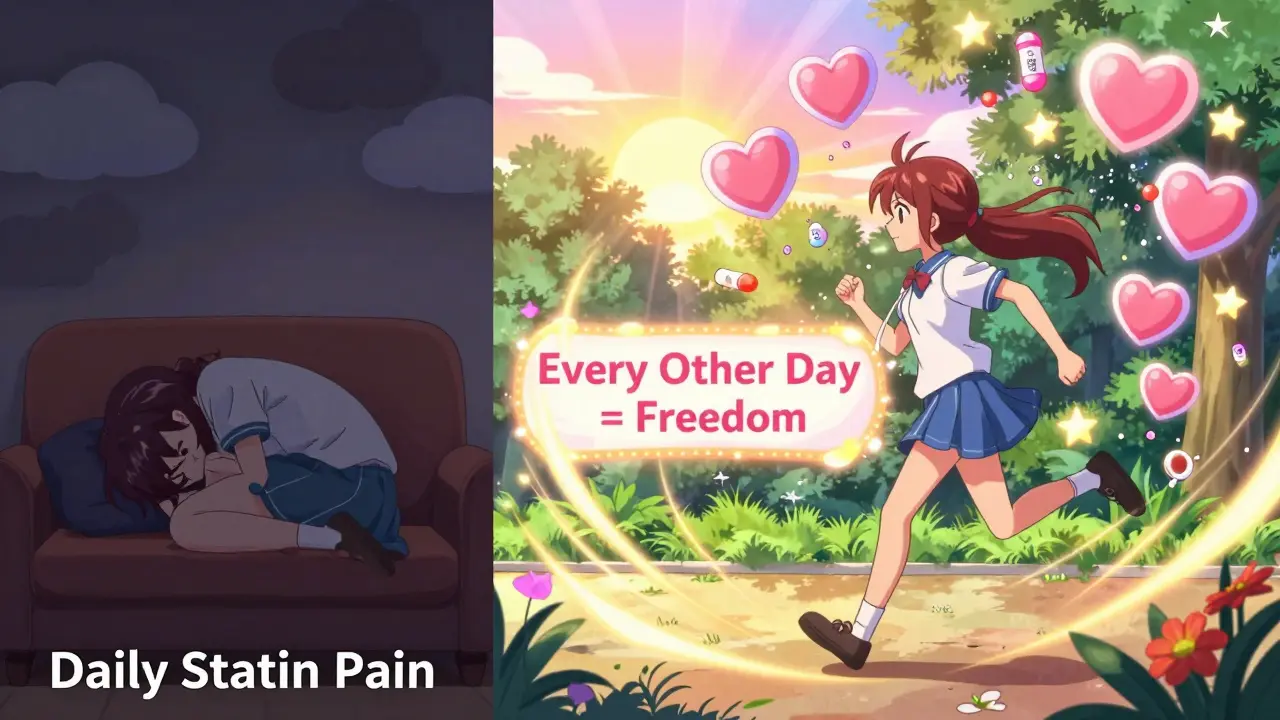
This is where alternate-day dosing really shines. In one study, 23 patients had tried daily atorvastatin or rosuvastatin and quit because of muscle pain. Zero of them could tolerate daily dosing. But when switched to every-other-day dosing - plus ezetimibe and colesevelam - 87% could stick with it. No more pain. No more quitting. Another study showed muscle-related side effects dropped by 30% to 50% with alternate-day dosing. That’s huge. For many, it’s the difference between being stuck on the couch and walking the dog again. Patients report things like: “I can climb stairs now.” “I don’t wake up stiff anymore.” “I finally feel like myself.” The key? It’s not about eliminating statins. It’s about using them smarter. You still get the anti-inflammatory and plaque-stabilizing benefits - the so-called “pleiotropic effects” - because the drug is still in your system most days.Which Statins Work? Which Don’t?
Not all statins are created equal. This strategy only works with ones that last long in your body. Best candidates:- Atorvastatin (Lipitor)
- Rosuvastatin (Crestor)
- Simvastatin
- Pravastatin
- Fluvastatin
- Lovastatin

Cost Savings and Real-World Benefits
Let’s talk money. Generic atorvastatin 20 mg? About $0.10 to $0.50 per pill. Rosuvastatin 10 mg? $0.20 to $1.00. Take it every other day? You’re using half the pills. That’s $150 to $300 saved per year. Compare that to PCSK9 inhibitors (Repatha, Praluent) - which cost $5,000 to $14,000 a year. Or even ezetimibe (Zetia) - $300 a year. Alternate-day statin dosing is cheaper than almost every alternative. And it’s not just about saving cash. It’s about saving your life. People who stop statins because of side effects have a 30% higher risk of heart attack or stroke. Alternate-day dosing keeps them on treatment. That’s priceless.Who Should Try It?
This isn’t for everyone. It’s for a specific group:- You’ve tried at least two daily statins and had muscle pain.
- Your creatine kinase (CK) levels are normal or only slightly elevated (under 10x the upper limit).
- You have heart disease, diabetes, or very high LDL - so you still need strong cholesterol control.
- You’re not pregnant or planning to be.
How to Start
If your doctor agrees this could work for you:- Switch from daily to every-other-day dosing. For example: take your usual dose on Monday, skip Tuesday, take Wednesday, skip Thursday, etc.
- Use a pill organizer or phone reminder. Missing a day isn’t the problem - forgetting you’re on this schedule is.
- Get your LDL checked in 4 to 6 weeks. If it’s not down enough, your doctor might add ezetimibe (a non-statin pill) to help.
- Keep checking in every 3 months. Stability matters more than speed.
- Track your muscle symptoms. Use a simple scale: 0 = no pain, 10 = unbearable. If pain drops, you’re on the right track.
What’s Missing? The Big Gaps
Here’s the honest truth: we don’t have long-term data. We don’t know if alternate-day dosing reduces heart attacks or strokes as well as daily dosing. No big trial has proven it yet. The American College of Cardiology says this: “Use it only after trying daily statins and failing.” They’re cautious - and rightly so. Daily statins have decades of outcome data. Alternate-day doesn’t. Also, insurance doesn’t always cover it. Some pharmacies won’t fill an every-other-day prescription unless it’s clearly documented as “statin intolerance.” You might need a letter from your doctor. And some patients get confused. “I skipped today - does that mean I’m off the drug?” That’s why visual schedules help. Write it down. Put it on your fridge.What Comes Next?
More research is coming. In 2023, the ACC/AHA guidelines said alternate-day dosing is a “reasonable option” for statin-intolerant patients - but they didn’t give it a strong recommendation. That’s changing. As generic statins get cheaper, and as more doctors see patients thrive on this approach, adoption is rising. A 2020 survey of lipid specialists found 68% use it regularly. In academic centers? 82%. The future? Maybe we’ll see formal guidelines. Maybe we’ll see trials comparing alternate-day dosing to newer drugs like bempedoic acid. But for now? It’s a practical, affordable, and effective bridge for people who otherwise have no good options.Final Thought
Statin intolerance doesn’t mean you’re doomed to high cholesterol. It doesn’t mean you can’t protect your heart. It just means you need a different plan. Alternate-day dosing isn’t perfect. But for many, it’s the difference between a life of pain and a life of movement. Between fear and freedom. Between giving up - and staying in the game. If you’ve struggled with statin side effects, ask your doctor: Could every other day work for me?Can I take statins every other day instead of daily?
Yes - but only with certain statins like atorvastatin or rosuvastatin. These have long half-lives, meaning they stay active in your body for over 14 hours. Taking them every other day can still lower LDL cholesterol nearly as well as daily dosing, while reducing muscle side effects. This approach is off-label and should be done under medical supervision.
Does alternate-day statin dosing reduce LDL as well as daily dosing?
It comes very close. Studies show alternate-day dosing achieves 92-95% of the LDL-lowering effect of daily dosing. For example, if daily atorvastatin 20 mg lowers LDL by 44%, every-other-day dosing lowers it by about 42%. The difference is not statistically significant in most trials. It’s not as strong as daily dosing, but it’s often strong enough to reduce heart risk significantly.
Which statins work for alternate-day dosing?
Only statins with long half-lives: atorvastatin (Lipitor) and rosuvastatin (Crestor). These stay active in your bloodstream for 14-30 hours. Short-acting statins like simvastatin, pravastatin, or fluvastatin don’t work well because they clear your system too quickly. Skipping a day means no cholesterol-lowering effect.
Will alternate-day dosing help with muscle pain from statins?
Yes - for many people. Studies show muscle-related side effects drop by 30-50% with alternate-day dosing. In one study, 87% of patients who couldn’t tolerate daily statins due to muscle pain were able to stay on the same drug when switched to every-other-day dosing. This is the main reason people choose this approach: to regain mobility and reduce discomfort without giving up treatment.
Is alternate-day statin dosing FDA-approved?
No. The FDA has not approved any statin for alternate-day dosing. It’s considered an off-label use. That means it’s legal and supported by clinical evidence, but not formally labeled for this purpose. Doctors can prescribe it if they believe it’s in the patient’s best interest - especially for those who can’t tolerate daily statins.
How much money can I save with alternate-day statin dosing?
You can save about 50% on your statin cost. Generic atorvastatin 20 mg costs as little as $0.10 per pill. Taking it every other day cuts your annual cost from around $30-$180 to $15-$90. Compare that to PCSK9 inhibitors ($5,000-$14,000/year) or even ezetimibe ($300/year). This makes alternate-day dosing one of the most cost-effective ways to manage statin intolerance.
Do I need to take other medications with alternate-day statin dosing?
Not always, but often. If your LDL doesn’t drop enough with alternate-day statins alone, your doctor may add ezetimibe (Zetia) or a bile acid sequestrant like colesevelam. These work differently and don’t cause muscle pain. Some patients do well on statin + ezetimibe every other day. The goal is to reach your LDL target without daily statin side effects.
How do I know if alternate-day dosing is working for me?
Check your LDL level 4-6 weeks after switching. If it’s down by at least 30-40%, it’s working. Track your muscle symptoms using a simple scale (0-10). If pain drops and your energy improves, you’re likely benefiting. Keep blood tests every 3 months until your levels stabilize. Always report new or worsening symptoms to your doctor.






Ryan Riesterer
January 20, 2026 at 14:08
Alternate-day atorvastatin dosing achieves 92–95% of LDL-lowering efficacy versus daily regimens, per the 2017 meta-analysis cited. Pharmacokinetic modeling confirms that Cmax and AUC remain within therapeutic thresholds due to the extended half-life (>14h) of lipophilic statins like atorvastatin and rosuvastatin. The non-linear pharmacodynamics of HMG-CoA reductase inhibition allow for sustained suppression despite intermittent dosing.