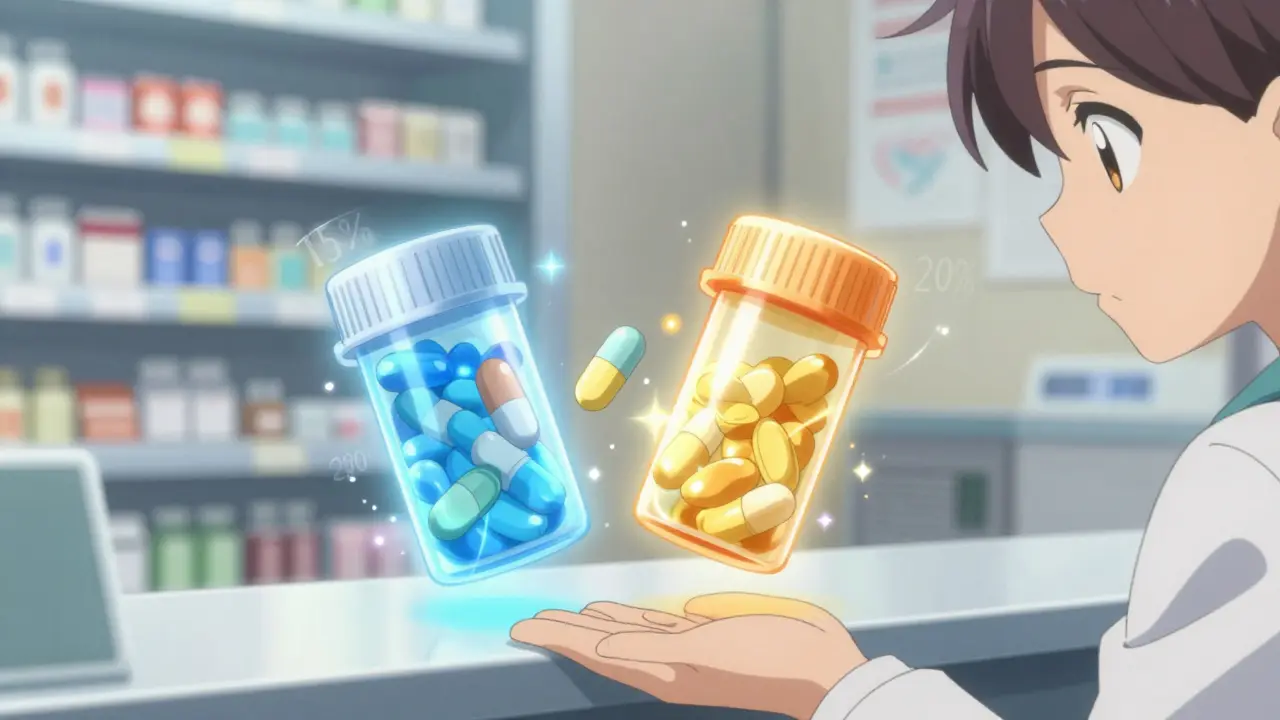
When you take two medications together - like a blood pressure pill and a water pill - you expect them to work the same way every time. But what happens when your pharmacist switches one of those pills to a different brand or generic version? It sounds simple: same ingredients, same dose. But in combination drugs, therapeutic equivalence isn’t always as straightforward as it looks. Even small differences in how the body absorbs each component can throw off the balance - and that’s where real risks creep in.
What Therapeutic Equivalence Really Means
Therapeutic equivalence isn’t just about having the same active ingredients. The U.S. Food and Drug Administration (FDA) defines it strictly: two products are therapeutically equivalent if they contain identical amounts of the same active drugs, in the same dosage form, taken the same way, and meet the same quality standards. This is tracked in the Orange Book, a public database updated every month. As of 2023, over 14,000 drug products have been rated, and about 95% carry an ‘A’ rating - meaning they’re considered interchangeable without clinical risk.
But here’s the catch: this rating applies to each component individually. In a combination product like amlodipine/benazepril (a blood pressure combo), both drugs must be bioequivalent on their own. The system doesn’t automatically guarantee that the combination behaves the same way across different manufacturers. That’s where things get tricky.
Why Dose Equivalents Don’t Always Add Up
Imagine two drugs working together: one reduces blood vessel tightness by 69%, the other cuts fluid retention by 89%. You might assume that swapping one generic for another with the same dose would give the same result. But it’s not that simple. The body doesn’t process each drug the same way when they’re combined. Some formulations release the drugs faster. Others bind differently in the gut. And if one component is absorbed 15% slower, it can throw off the entire balance.
Studies show this isn’t theoretical. A 2018 study in the Journal of Clinical Endocrinology & Metabolism found that 12% of patients switching between different generic versions of levothyroxine (a thyroid hormone) had abnormal lab results - even though both met FDA bioequivalence standards. That’s because tiny changes in inactive ingredients (like fillers or coatings) can affect how the drug dissolves, especially in sensitive populations.
For combination products, this gets worse. Take tramadol and acetaminophen: one is an opioid painkiller, the other is a fever reducer. Their combined effect isn’t just the sum of each drug - it’s a synergistic interaction. A 2014 study used complex modeling to show that even small shifts in absorption rates between generics could reduce pain relief by up to 20% in some patients. That’s not a minor difference. That’s a patient in avoidable pain.
The Hidden Risks: Narrow Therapeutic Index Drugs
Some drugs live on a razor’s edge. Too little? The condition returns. Too much? You get poisoned. These are called narrow therapeutic index (NTI) drugs - and they’re common in combinations. Think warfarin (blood thinner), phenytoin (seizure control), or levothyroxine. When these are paired with other meds - say, a statin and a blood pressure pill - the margin for error shrinks even further.
The FDA requires stricter bioequivalence testing for NTI drugs: 90-111% instead of the usual 80-125%. But even that doesn’t catch everything. In 2022, the FDA’s adverse event database recorded 247 incidents linked to dose errors in combination products. Nearly 40% involved cardiovascular combinations. One patient switched from a brand to generic amlodipine/valsartan and ended up in the ER with dangerously low blood pressure. The generic used a different disintegrant - sodium starch glycolate instead of croscarmellose sodium - and it changed how fast the drug entered the bloodstream.

What Happens in Real Clinics
Pharmacists know this better than anyone. On pharmacy forums, stories flood in:
- A pharmacist in Ohio reported three dosing errors in six months from switching between different generic versions of amlodipine/benazepril. One patient got 10/20mg instead of 5/20mg - a 100% increase in the beta-blocker component.
- A nurse practitioner in Texas saw a patient’s LDL cholesterol jump 15% after switching from brand-name Vytorin (ezetimibe/simvastatin) to a generic. The generic had a different coating that slowed absorption, reducing the statin’s effectiveness.
- Meanwhile, another hospital saved $1.2 million a year by switching to generic proton pump inhibitor combos - with zero adverse events. Why? Because they used standardized protocols and monitored patients closely.
It’s not about generics being bad. It’s about not treating them like they’re all the same.
How to Manage This Safely
The FDA gives clear steps for checking therapeutic equivalence:
- Confirm both drugs in the combo have identical active ingredients and strengths.
- Verify the dosage form (tablet, capsule, liquid) and route (oral, topical, etc.) are the same.
- Check the TE code in the FDA’s Orange Book. ‘A’ means interchangeable. ‘B’ means don’t substitute.
But that’s just the start. Here’s what works in practice:
- Use standardized conversion tables - especially for NTI combos. Don’t rely on memory or vague guidelines.
- Scan barcodes at the pharmacy counter. It catches mismatched strengths and prevents manual entry errors.
- Monitor for 72 hours after switching. Check blood pressure, INR, thyroid levels, or cholesterol. Don’t assume it’s fine.
- Document every switch - including the manufacturer and lot number. If something goes wrong, you need to trace it.
One health system in California cut substitution errors by 65% after a 40-hour training program for staff. They didn’t just teach the rules - they taught the why.

The Future: Personalized Equivalence?
The FDA is already working on new tools. In 2023, they released draft guidance for complex combination products - especially those with non-linear dose responses. They’re also testing machine learning models that predict which generic combinations are likely to cause problems, based on formulation differences. Early results show 89% accuracy.
Looking ahead, the push is toward personalized therapeutic equivalence. By 2030, pharmacogenomics may play a role: if a patient metabolizes drugs slowly due to genetics, their ‘equivalent’ dose might be lower than someone else’s. That’s not science fiction - it’s already being tested in clinical trials.
But until then, the rule is simple: don’t assume. Just because two pills look the same doesn’t mean they act the same - especially when they’re paired.
What You Should Do
If you’re on a combination drug:
- Ask your pharmacist: Is this generic the same manufacturer as before?
- Don’t panic if it changes - but do monitor how you feel for the next week.
- Ask for a copy of the TE code from the Orange Book if you’re unsure.
- Report any unusual symptoms after a switch - even if they seem minor.
If you’re a provider:
- Don’t automatically substitute. Evaluate the combo as a unit, not two separate drugs.
- Use electronic prescribing systems that flag potential substitution issues.
- Keep a list of high-risk combos in your clinic - especially those with NTI drugs.
What does an ‘A’ rating mean in the FDA Orange Book?
An ‘A’ rating means the drug product has been evaluated by the FDA as therapeutically equivalent to the reference listed drug. This means it contains the same active ingredients, strength, dosage form, and route of administration, and meets all quality standards. It can be substituted without clinical concern under most circumstances.
Can different generic versions of the same combination drug have different effects?
Yes. Even if two generics have the same active ingredients and strength, differences in inactive ingredients (like fillers, coatings, or disintegrants) can affect how quickly the drug is absorbed. This is especially critical in combination products and for drugs with a narrow therapeutic index, like warfarin or levothyroxine. A 10-15% change in absorption can lead to reduced effectiveness or increased side effects.
Why are combination drugs harder to manage than single-drug generics?
Combination drugs involve two or more active ingredients, each with its own absorption, metabolism, and elimination profile. When you switch generics, you’re not just changing one component - you’re changing the interaction between two. This can alter the overall effect in unpredictable ways. For example, one generic might release the first drug faster, while another releases the second more slowly - creating a mismatch in timing that affects the intended synergy.
What should I do if my combination drug is switched without warning?
Monitor for changes in symptoms over the next 5-7 days. For blood pressure, diabetes, or thyroid meds, check your readings more often. If you notice new side effects - dizziness, fatigue, unusual bleeding, or worsening symptoms - contact your provider immediately. Request the manufacturer name and lot number from your pharmacy so you can track the change. Always ask if the substitution was intentional.
Are brand-name combination drugs safer than generics?
Not necessarily. Brand-name and generic drugs must meet the same FDA standards for safety and effectiveness. The difference lies in consistency. Brand-name products are often made by one manufacturer with stable formulations. Generics may come from multiple manufacturers, each with slightly different inactive ingredients. The risk isn’t safety - it’s variability. That’s why tracking and monitoring matter more than the brand name.





phyllis bourassa
March 6, 2026 at 13:24
Okay but let’s be real - if your pharmacist swaps your combo pill and you don’t notice your legs turning to jelly or your head feels like a balloon, you’re lucky. I had a friend switch generics and ended up in the ER because her BP dropped like a rock. No one warned her. No one asked. Just ‘same ingredients, same dose.’ Bullshit. The body ain’t a math equation.
And don’t even get me started on how pharmacies don’t track lot numbers. If you’re on a combo with a narrow therapeutic index, you’re basically gambling. And the casino? It’s run by a guy in a white coat who just wants to hit his quota.
Also - why is no one talking about how generic manufacturers change fillers like they’re switching out cereal brands? One day it’s cornstarch, next day it’s lactose monohydrate. Your gut doesn’t care. Your liver does.
Stop treating patients like lab rats. We’re not interchangeable.
Also - yes, I’m mad. You’re welcome.