
Imagine taking a pill four times a day when your doctor meant just once. That’s not a hypothetical scenario-it’s happened to real people, with serious consequences. A construction worker drove his 7-year-old daughter to school every morning for a week while overdosing on a sedative because he misread "QD" as "QID." He didn’t realize his mistake until he went back for a refill. This isn’t rare. It’s one of the most common-and preventable-medication errors in healthcare today.
What QD and QID Really Mean
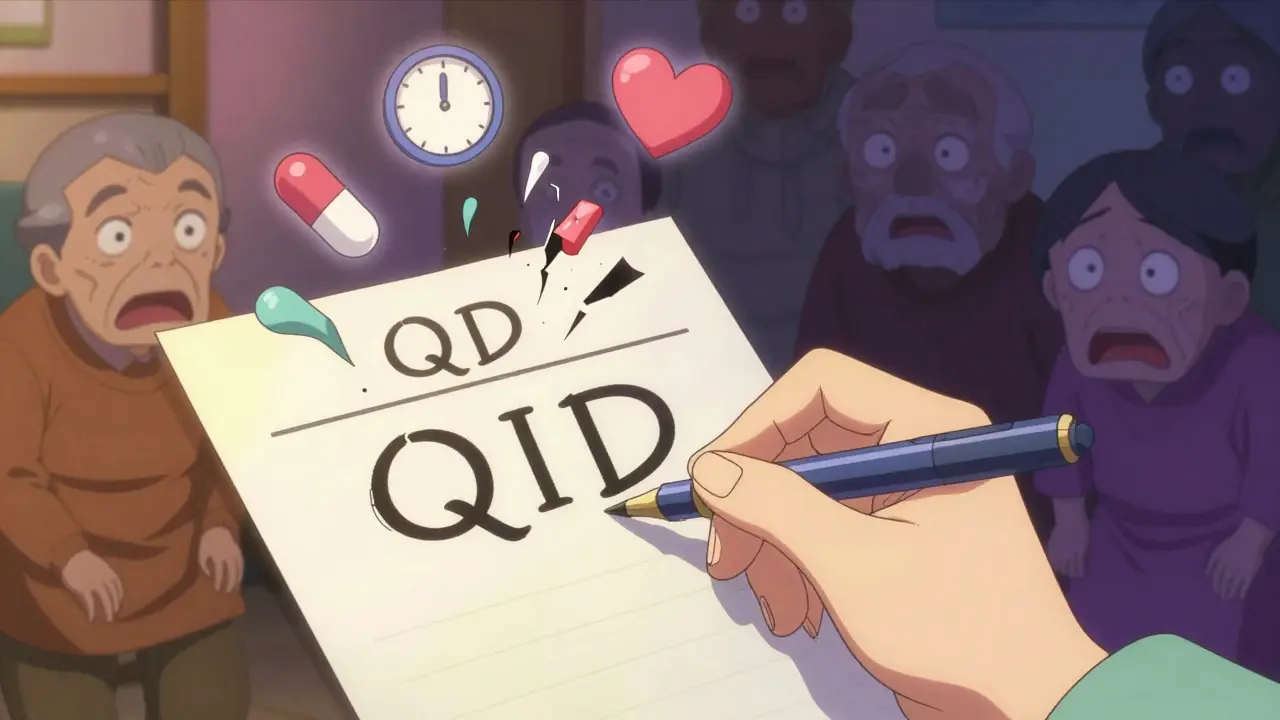
QD stands for "quaque die," Latin for "once daily." QID means "quater in die," or "four times daily." These abbreviations have been used for centuries, but they’re not just outdated-they’re dangerous. The problem isn’t that the abbreviations are hard to understand. It’s that they look too similar. A quick glance, a sloppy handwriting, or a tired pharmacist can turn "QD" into "QID"-and suddenly, a patient gets four times the dose they were supposed to.
What’s worse, many people assume QID means every 6 hours. It doesn’t. It means four doses spread out during waking hours-say, 7 AM, 1 PM, 7 PM, and 11 PM. Same with QD: it’s not "every 24 hours on the dot." It’s once a day, at roughly the same time. But when a doctor writes "1 tab QD," and a pharmacist reads "QID," the patient ends up with four pills instead of one. That’s not a typo. That’s a safety failure.
Why This Confusion Still Exists
You’d think by now, this would be fixed. After all, the Institute for Safe Medication Practices flagged QD and QID as high-risk in 2001. The Joint Commission banned them in 2004. The FDA says abbreviation-related errors make up about 5% of all medication errors reported. And yet, these abbreviations linger.
Why? Because some doctors still write them by hand. Even with electronic health records (EHRs) everywhere, 30% of handwritten prescriptions still use QD and QID, according to the American Medical Association. Independent practitioners, rural clinics, and older providers who haven’t fully switched to digital systems are the main culprits. A 2023 survey found that 31% of community pharmacies still see these abbreviations on paper scripts.
And it’s not just doctors. Pharmacists misread them too. One nurse practitioner on AllNurses.com described a case where a patient’s blood pressure dropped to 80/50 after the pharmacy dispensed "take four times daily" on a prescription that clearly said "QD." The patient didn’t question it. They trusted the label.
The Real Cost of a Single Mistake
One wrong dose can spiral fast. A patient on warfarin who took it four times daily instead of once had an INR of 12.3-normally, it’s around 2 to 3. That’s a life-threatening risk of internal bleeding. They ended up in the hospital. Another patient, prescribed a once-daily blood pressure pill, took it four times and collapsed at home. Their family found them unconscious.
The American Geriatrics Society found that 68% of documented QD/QID errors involve patients over 65. Why? Because older adults often take five, six, or more medications. A confusing label on one pill can throw off their whole regimen. And they’re less likely to double-check-especially if they’ve been taking the same drug for years.
According to the National Patient Safety Foundation, 63% of patients admit they’ve been unsure about their dosing instructions at least once. "QD vs QID" ranked third on their list of most confusing instructions-right after "take with food" and "take on empty stomach."
How This Error Kills
It’s not just about drowsiness or dizziness. Overdosing on blood thinners, sedatives, diabetes meds, or heart drugs can lead to strokes, organ failure, or death. The Joint Commission estimates that abbreviation-related errors contribute to over 100 deaths a year in the U.S. alone. The National Coordinating Council for Medication Error Reporting and Prevention classifies QD/QID mix-ups as "Category E" errors-meaning they caused harm that required medical intervention-in 78% of cases.
The economic toll is just as staggering. The Medicare Payment Advisory Commission estimates that medication errors tied to misread prescriptions cost the U.S. healthcare system $2.1 billion annually. Of that, $780 million comes directly from dosing frequency errors like QD/QID confusion.
What’s Being Done to Stop It
Change is happening-but slowly. In 2023, the American Medical Association updated its guidelines to mandate writing out "daily" instead of "QD." The FDA’s new draft guidance says to ditch Latin abbreviations entirely. Epic and Cerner, the two biggest EHR systems, now block providers from saving prescriptions with "QD" or "QID." If you try to type it, the system won’t let you proceed.
Pharmacies are adapting too. The University of Michigan Health System found that requiring pharmacists to verbally confirm dosing frequency with every new prescription cut errors by 67%. That’s huge. It means asking the patient: "How often are you supposed to take this?"-not assuming they know what "QID" means.
Visual aids help too. A Johns Hopkins study in 2023 showed that adding simple icons-like a sun for "once daily" and four suns for "four times daily"-reduced confusion by 82%. Patients remembered the pictures better than the words.

What You Can Do
If you’re a patient: Always ask. If your prescription says "QD" or "QID," say: "Can you write that out?" Ask the pharmacist: "Is this once a day or four times a day?" Don’t be shy. You’re not wasting their time-you’re saving your life.
If you’re a caregiver: Double-check. Older adults often forget or misremember. Keep a written list of all their medications with times and doses. When a new prescription comes in, compare it to the list.
If you’re a healthcare worker: Stop using abbreviations. Period. Write "once daily," "twice daily," "three times daily," "four times daily." It takes three extra letters. That’s it. And it prevents mistakes that can kill.
The Bottom Line
QD and QID aren’t medical terms. They’re shortcuts that cost lives. Every time a doctor writes "QD," they’re betting that someone will read it right. That’s not a risk worth taking. The fix is simple: write it out. Use plain language. Add icons. Verify verbally. Train staff. Audit reports. Hospitals that did all this saw a 42% drop in dosing errors within a year.
Medication safety isn’t about fancy technology. It’s about clear communication. And if we can stop a patient from taking four pills instead of one just by writing out "daily," then we owe it to them to do it.







Jimmy V
March 14, 2026 at 04:00
QD and QID aren't just confusing-they're deadly. I work in a pharmacy and see this every week. One guy came in for his blood thinner, said his doctor told him 'once a day,' but the script said QID. He'd been taking four pills. Lucky he didn't bleed out. Write it out. Plain. English. No Latin. It's not hard.