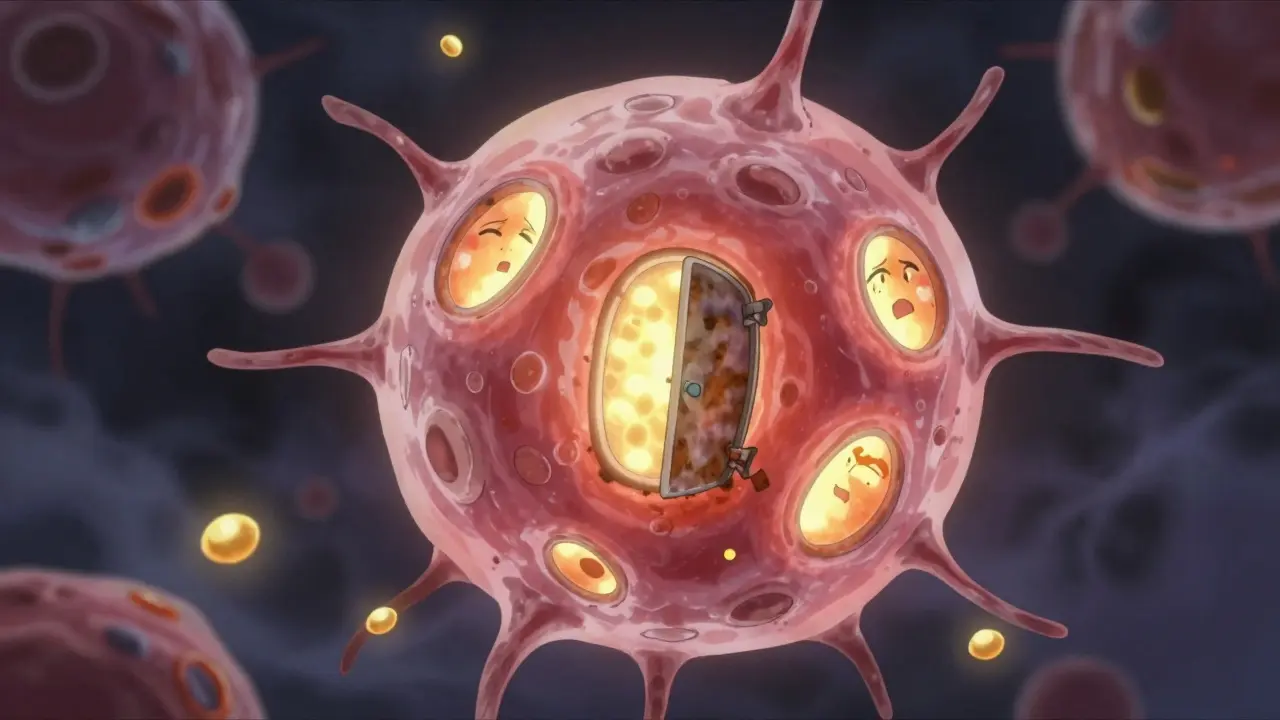
When your body stops responding properly to insulin, things start to fall apart - slowly at first, then all at once. This isn’t just about high blood sugar. It’s about your entire metabolism going off track. And for most people with type 2 diabetes, the story begins long before they ever hear the word "diabetes." It starts with insulin resistance.
What Exactly Is Insulin Resistance?
Insulin is the hormone your pancreas makes to tell your cells: "Take in glucose from the blood." When you eat, blood sugar rises, insulin is released, and muscle, fat, and liver cells open their doors to absorb that sugar for energy or storage. But with insulin resistance, those doors get stuck. They don’t open as easily. The cells ignore insulin’s signal.
It’s not that insulin disappears. In fact, your body makes more of it - constantly. The pancreas tries to compensate by pumping out extra insulin to force glucose into cells. This leads to high insulin levels in the blood - a condition called hyperinsulinemia. For years, this works. Blood sugar stays normal. But over time, the pancreas gets worn down. Beta cells tire out. They can’t keep up. And that’s when blood sugar starts climbing into the prediabetes range - and eventually, type 2 diabetes.
Research from the University of Texas Health Science Center shows that 80-90% of people diagnosed with type 2 diabetes already had significant insulin resistance years before their diagnosis. It’s not a sudden event. It’s a slow leak.
Metabolic Syndrome: More Than Just a List of Numbers
Metabolic syndrome used to be called Syndrome X. Now, experts are pushing to rename it metabolic dysfunction syndrome - because it’s not just a collection of symptoms. It’s a system failure.
The International Diabetes Federation says you have metabolic syndrome if you have at least three of these five signs:
- Waist size over 94 cm for men (European), 90 cm for South Asian or East Asian men, or over 80 cm for women of any background
- Triglycerides at or above 150 mg/dL
- HDL cholesterol below 40 mg/dL for men or 50 mg/dL for women
- Blood pressure at 130/85 mmHg or higher
- Fasting blood sugar of 100 mg/dL or more
These aren’t random numbers. They’re warning signs from your body. High waist circumference? That’s fat packed around your organs - visceral fat - which releases inflammatory chemicals that make insulin resistance worse. High triglycerides and low HDL? That’s your fat metabolism out of sync. High blood pressure? Your blood vessels are under strain from excess sugar and inflammation. And elevated fasting glucose? That’s your pancreas losing the battle.
Having just one of these doesn’t mean much. But having three? That’s when your risk of heart disease jumps 200-300%. And your chance of developing type 2 diabetes? It goes up 5 to 6 times.
Why Insulin Resistance Is the Core Problem
Metabolic syndrome doesn’t happen because you eat too much sugar alone. It happens because your body’s ability to handle energy is broken. And insulin resistance is the broken switch.
When you eat a meal, glucose and fats enter your bloodstream. In a healthy person, insulin opens the door for those nutrients to go into muscle and fat cells. In someone with insulin resistance, those cells don’t respond. So glucose stays in the blood. Fats get redirected - not into storage, but into the liver. That’s how fatty liver disease (NAFLD) starts. And when fat builds up in the liver, it makes insulin resistance even worse. It’s a loop.
Chronic overeating - especially refined carbs and added sugars - floods your system with glucose and free fatty acids. These molecules interfere with the insulin signaling pathway. They trigger inflammation in fat tissue. They cause stress in the endoplasmic reticulum - the cell’s protein factory. This stress tells your body: "We’re in danger." So it releases more inflammatory signals. And those signals make insulin resistance worse.
It’s not about willpower. It’s about biology. Two people can eat the same diet. One stays lean and healthy. The other gains belly fat and develops metabolic syndrome. Why? Genetics. Fat distribution matters. People who store fat inside the abdomen or liver are at far higher risk than those who store it under the skin.
The Transition from Prediabetes to Diabetes
Prediabetes isn’t a disease. It’s a red flag. Your blood sugar is too high - but not high enough yet for a diabetes diagnosis. Fasting glucose between 100-125 mg/dL. HbA1c between 5.7% and 6.4%.
At this stage, your pancreas is still working overtime. It’s producing more insulin than ever. But the cells are becoming more resistant. The liver keeps dumping glucose into the blood, even when you’re fasting. Muscle cells stop taking in glucose efficiently.
Then comes the breaking point. Beta cells - the insulin-producing cells in your pancreas - start dying off. Research from Joslin Diabetes Center shows they decline at about 4-5% per year in people with insulin resistance. When enough are lost, insulin production drops. Blood sugar spikes. You cross the line into type 2 diabetes.
Here’s the hard truth: once you’re diagnosed with type 2 diabetes, you’re not just dealing with high sugar. You’re dealing with a system that’s been damaged for years. The longer insulin resistance goes untreated, the harder it is to reverse.
What Works: Lifestyle Changes That Actually Move the Needle
Medications help. But the most powerful tool you have? Your own behavior.
The Diabetes Prevention Program - a landmark study with over 3,000 participants - showed that losing just 7% of your body weight and doing 150 minutes of moderate exercise per week (like brisk walking) cut the risk of developing type 2 diabetes by 58%. That’s more effective than metformin.
How do you get there?
- Focus on whole foods: vegetables, legumes, lean proteins, nuts, seeds. Avoid sugary drinks, white bread, pastries, and processed snacks.
- Move daily: walk after meals. It lowers blood sugar faster than any pill. Even 10 minutes after dinner helps.
- Sleep well: poor sleep increases cortisol, which raises blood sugar and makes fat harder to lose.
- Manage stress: chronic stress keeps insulin levels high and cravings for sugar intense.
The Look AHEAD trial found that people who lost 10% of their body weight had a 51% chance of reversing prediabetes in just one year. Twelve percent were still in remission after eight years. Remission isn’t a cure. But it’s possible - and it happens when insulin sensitivity improves.

Medications: When Lifestyle Isn’t Enough
Metformin is still the first-line drug for prediabetes and early type 2 diabetes. It works by reducing liver glucose output and improving insulin sensitivity. In the Diabetes Prevention Program, it lowered diabetes risk by 31% - not as strong as lifestyle, but still very effective.
Newer drugs like semaglutide (Ozempic, Wegovy) and tirzepatide (Mounjaro) are changing the game. These GLP-1 and GIP receptor agonists don’t just lower blood sugar. They reduce appetite, slow digestion, and help you lose weight. In the STEP trials, semaglutide led to nearly 15% average weight loss over 68 weeks. In the SELECT trial, 66% of participants with type 2 diabetes achieved remission.
They’re expensive. And they’re not magic. But for people with severe insulin resistance and metabolic syndrome, they’re a lifeline.
What’s Next: A New Way to Think About the Disease
Experts are starting to drop the term "metabolic syndrome." They’re replacing it with metabolic dysfunction syndrome. Why? Because "syndrome" sounds like a list of symptoms. "Dysfunction" says: this is a broken system.
The European Association for the Study of Diabetes plans to release new diagnostic criteria by late 2025. It will likely focus on insulin resistance as the core driver - not just waist size or cholesterol.
Meanwhile, stem cell therapies are showing promise. Vertex Pharmaceuticals’ VX-880 treatment - which replaces damaged beta cells with lab-grown ones - helped 71% of patients reach normal blood sugar levels without insulin in early trials.
And continuous glucose monitors (CGMs) are now FDA-approved for use by people without diabetes. Dexcom G7, launched in late 2023, gives real-time data on how your body responds to food, sleep, and movement. For someone with insulin resistance, this isn’t just a gadget. It’s a mirror.
Final Thought: It’s Not Too Late
If you’ve been told you have prediabetes, or you have high blood pressure and belly fat, or your triglycerides are up and HDL is down - don’t panic. But don’t ignore it either.
Type 2 diabetes doesn’t come out of nowhere. It’s the end result of years of insulin resistance. And that means you have time. The window to reverse it is still open. For most people, it’s not about drastic diets or extreme workouts. It’s about small, consistent changes: moving more, eating real food, sleeping better, and giving your body a chance to heal.
The science is clear. Your body wants to work. It just needs the right conditions.
Can you reverse insulin resistance?
Yes - especially in the early stages. Studies show that losing 5-7% of body weight, exercising regularly, and eating a low-refined-carb diet can restore insulin sensitivity in most people. The Look AHEAD trial found that 51% of participants with prediabetes and metabolic syndrome reversed their condition within a year of intensive lifestyle changes. Reversal means blood sugar returns to normal without medication. It’s not permanent unless you maintain the habits.
Is metabolic syndrome the same as type 2 diabetes?
No. Metabolic syndrome is a cluster of risk factors - including insulin resistance, high blood pressure, and abnormal cholesterol - that greatly increase your chance of developing type 2 diabetes and heart disease. You can have metabolic syndrome without diabetes. But if you have it, your risk of becoming diabetic is 5-6 times higher than someone without it. Think of metabolic syndrome as the warning sign. Type 2 diabetes is the outcome if nothing changes.
Do all overweight people develop metabolic syndrome?
No. Only about 30-40% of people who are overweight or obese develop metabolic syndrome. Genetics play a big role. Some people store fat under the skin (subcutaneous), which is less harmful. Others store fat around organs (visceral), which triggers inflammation and insulin resistance. That’s why two people with the same BMI can have very different health risks.
Can you have insulin resistance without being overweight?
Yes. While obesity is the most common cause, lean people can have insulin resistance too - especially those with genetic risks, like South Asians or people with a strong family history of diabetes. In fact, up to 20% of people with type 2 diabetes are not overweight. Their bodies just don’t handle sugar well. This is why doctors now check fasting insulin levels and HOMA-IR scores, not just weight.
How long does it take to improve insulin sensitivity?
You can start seeing improvements in as little as 2-4 weeks. A single bout of exercise can make your muscles more sensitive to insulin for up to 48 hours. Consistent walking, strength training, and cutting sugar can reduce insulin resistance by 20-30% in 3 months. Weight loss of 5% typically brings insulin levels down significantly. The key is consistency - not perfection.