When a brand-name drug’s patent runs out, you’d think generic versions would flood the market right away. But that’s not how it works. In the U.S., a generic company might wait years after patent expiration before it can sell its version. In Europe, the delay might be even longer. And in some countries, generics may never arrive at all - even when the patent is gone. This isn’t a glitch. It’s by design.
Why Do Exclusivity Periods Exist?
Pharmaceutical companies spend an average of $2.3 billion and over a decade to get one new drug approved. That’s not just R&D - it’s clinical trials, regulatory filings, and failed attempts. The system gives them a temporary monopoly to recoup that investment. But once that protection ends, generics should step in to slash prices. The problem? The rules aren’t the same anywhere.How Long Is the Patent Really Good For?
The global standard for patent length is 20 years from the filing date, set by the TRIPS Agreement in 1995. Sounds straightforward, right? But here’s the catch: most drugs are patented 10 to 12 years before they even hit the market. By the time the FDA or EMA approves it, the patent may already have just 6 to 10 years left. That’s why companies rely on extra protections - not just patents, but exclusivity periods that block generics even if the patent expires.The U.S. System: A Maze of Overlapping Protections
The U.S. has the most complex system in the world. It’s built on the Hatch-Waxman Act of 1984, which created a balance between innovation and access. But over time, it’s become a tool for extending monopolies.- New Chemical Entity (NCE) exclusivity: 5 years. No generic can even file an application during this time.
- Orphan Drug Exclusivity: 7 years for drugs treating rare diseases. This can stack on top of NCE exclusivity.
- 3-year exclusivity: For new uses, new formulations, or new patient groups - even if the active ingredient isn’t new.
- Patent Term Extension (PTE): Up to 5 extra years, but the total post-approval protection can’t exceed 14 years.
- 180-day generic exclusivity: The first generic company to successfully challenge a patent gets a 180-day window where no other generic can enter. This sounds fair - until you realize brand companies often pay generics to delay entry. These "pay-for-delay" deals were ruled illegal in FTC v. Actavis in 2013, but they still happen.
Europe’s 8+2+1 Rule: Simpler, But Slower
The EU doesn’t have patent term extensions like the U.S. Instead, it uses a system called "8+2+1":- 8 years of data exclusivity: Generic companies can’t use the brand’s clinical trial data to get approval.
- 2 years of market exclusivity: Even if a generic gets approved, it can’t be sold.
- 1-year extension: If the original drug gets a new indication with significant clinical benefit.
Canada, Japan, and Other Countries: A Patchwork of Rules
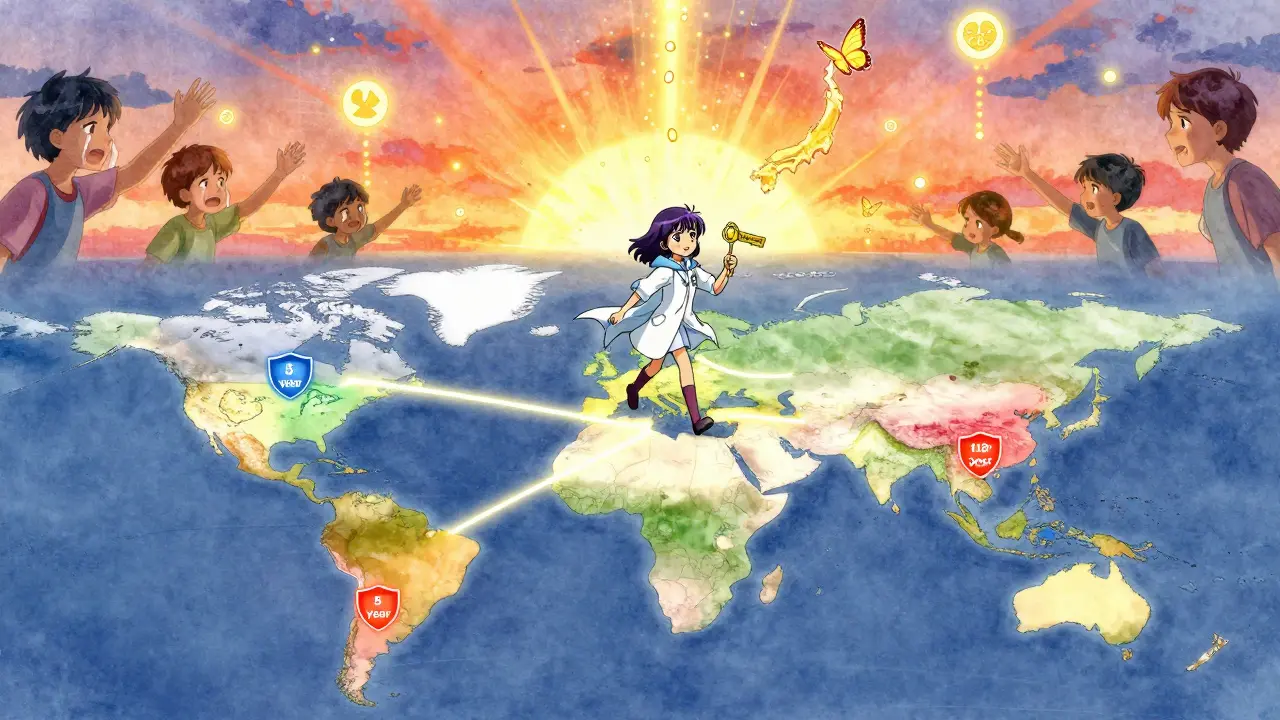
Canada’s rules are similar to the EU: 8 years of data protection, then 2 years before generics can sell. Japan gives 8 years of data exclusivity and 4 years of market protection - longer than the U.S. for some drugs. China changed its rules in 2020, extending data exclusivity from 6 to 12 years. Brazil did the same in 2021 with a 10-year rule. These changes aren’t random. They’re often pushed by trade deals. The EU’s CETA agreement with Canada, for example, forced Canada to extend data exclusivity beyond what it had. Similar provisions have blocked generic HIV drugs in South Africa for up to 11 years after patents expired, according to Health Action International.Why This Matters for Patients and Prices
When a brand-name drug loses exclusivity, its price typically drops by 80-90% within a year. That’s why the timing of generic entry is a public health issue. In high-income countries, generics usually arrive after about 12.7 years. In low-income countries, it takes nearly 19.3 years - not because of patents, but because of data exclusivity rules copied from wealthy nations. The WHO found that many developing countries are now adopting these strict rules under pressure from trade agreements, even when they can’t afford the brand-name drugs. The financial stakes are massive. EY estimates $356 billion in branded drug sales will face patent expiration between 2023 and 2028. That’s billions in savings waiting to be unlocked - if generics can get in.What’s Changing? The Push for Reform
Critics say the system is broken. Dr. Aaron Kesselheim from Harvard found that originator companies now file an average of 38 additional patents per drug - many on trivial changes. The FDA’s former director, Dr. Janet Woodcock, admitted the agency is "walking a tightrope" between innovation and access. In 2023, the U.S. reintroduced the Preserve Access to Affordable Generics and Biosimilars Act, which would make "pay-for-delay" deals harder to hide. The EU proposed cutting data exclusivity to 5 years for some drugs, but that’s still under debate. Japan plans to speed up its patent review system to cut delays. Yet the pharmaceutical industry remains firm. IFPMA reported in December 2023 that 97% of its members see the current system as "essential" for innovation. They argue that without long exclusivity, no company would risk spending billions on drugs that might fail in Phase III trials.
What This Means for Generic Manufacturers
If you’re a generic company trying to enter the market, you’re playing a high-stakes game. You need to:- Identify which patents are weak or likely invalid
- File a Paragraph IV certification in the U.S. (a legal challenge)
- Pay millions in legal fees
- Wait years for a court decision
- Hope you’re the first to win - because only the first gets the 180-day exclusivity window
Is the System Fair?
There’s no easy answer. On one hand, without protection, innovation would slow. No one would spend $2.3 billion on a drug that could be copied the day it’s approved. On the other hand, patients in the U.S. pay 3-5 times more for the same drugs than in Canada or Europe. And in poor countries, lifesaving medicines remain out of reach for years after patents expire. The system was meant to balance two goals: reward innovation and ensure access. Today, it often favors the former - at the cost of the latter.How long do generic drugs have to wait after a patent expires to enter the market?
The wait depends on the country and the type of exclusivity. In the U.S., a generic can enter immediately after patent expiration - unless there’s still data exclusivity or another regulatory protection in place. For example, a New Chemical Entity has 5 years of data exclusivity, meaning no generic can even apply for approval during that time. In the EU, generics can’t use the original drug’s data for 8 years, and can’t be sold for another 2 years after approval - even if the patent is gone. So while the patent may expire in year 12, the drug might not face generic competition until year 11 or even year 14.
What is the 180-day exclusivity period for generics in the U.S.?
This is a unique U.S. rule created by the Hatch-Waxman Act. The first generic company to successfully challenge a patent (through a Paragraph IV certification) gets 180 days of exclusive rights to sell its version - no other generic can enter during that time. It’s meant to reward the company that takes the legal risk. But it’s also been exploited. Sometimes, the brand company pays the first generic to delay entry. These "pay-for-delay" deals can stretch the 180-day window into years, which is why the FTC has been fighting them in court.
Why do some countries block generics even after patents expire?
Because of data exclusivity. Even if a patent expires, generic companies can’t use the original drug’s clinical trial data to prove their product is safe and effective. In the U.S., this lasts 5 years for new chemical entities. In the EU, it’s 8 years. Some countries, like China and Brazil, now have 10-12 years of data exclusivity. This means generics can’t enter the market until that period ends - regardless of patent status. These rules are often included in international trade deals, forcing poorer countries to adopt rules that protect U.S. and European drugmakers.
Can a drug have multiple exclusivity periods at once?
Yes. A single drug can have overlapping exclusivities. For example, a new drug for a rare disease (orphan drug) can get 7 years of orphan exclusivity, plus 5 years of NCE exclusivity, plus a 3-year exclusivity for a new formulation. These can stack, meaning a drug might be protected for over 12 years without any patent. This is common in oncology and rare disease drugs. The FDA allows this, and companies strategically file for multiple types to extend their monopoly.
What’s the difference between a patent and exclusivity?
A patent is a legal right granted by the government that prevents others from making, using, or selling the invention - in this case, the drug molecule or formulation. Exclusivity is a regulatory protection granted by the FDA or EMA that prevents generic companies from using the original drug’s data to get approved. You can lose a patent in court, but exclusivity still stands. And you can have exclusivity even if there’s no patent. That’s why many drugs remain protected long after patents expire.




Abby Polhill
December 24, 2025 at 00:53
The whole patent-exclusivity maze is a masterclass in regulatory arbitrage. Companies aren't just extending patents-they're layering regulatory shields like an onion, each peel revealing another layer of legal protection. Data exclusivity isn't just a buffer-it's a weaponized delay tactic disguised as innovation incentive. And the 180-day first-filer window? More like a cartel entry ticket. The FDA’s Orange Book reads like a corporate playbook, not a public health document.