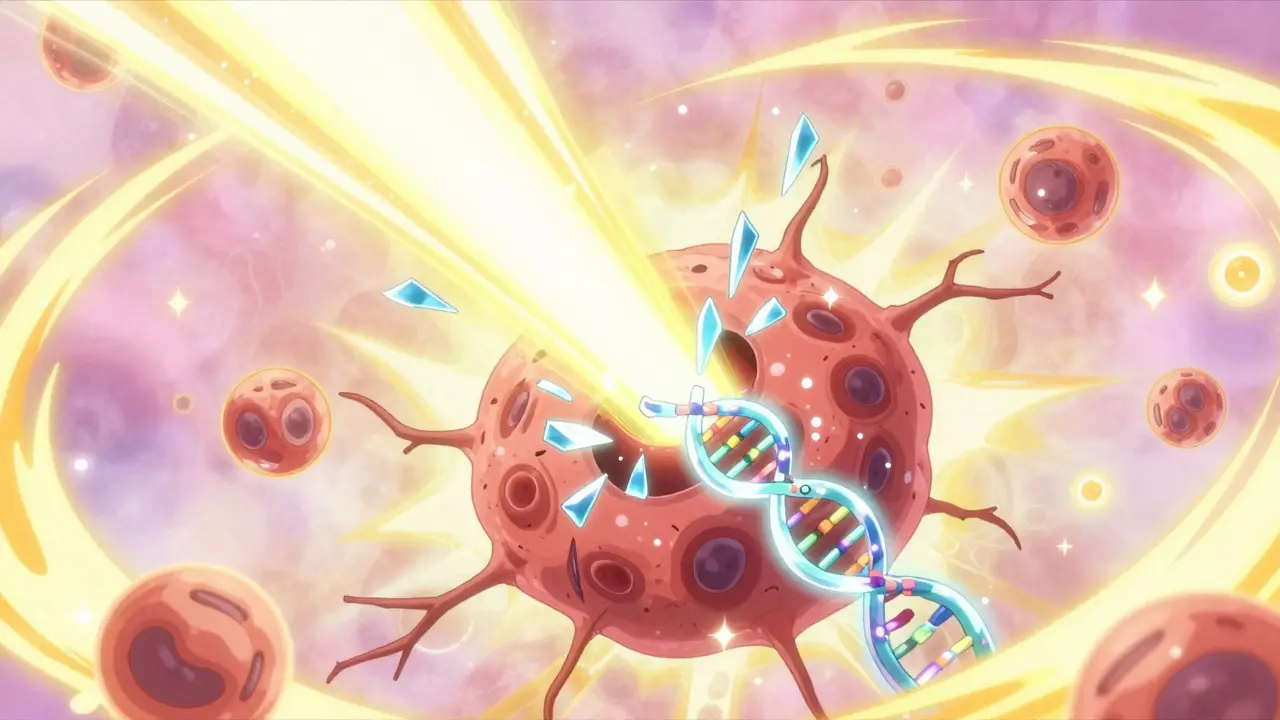
When you hear the word radiation, you might think of nuclear accidents or X-ray machines. But for millions of cancer patients, radiation is a precise, life-saving tool. Radiation therapy doesn’t just zap tumors-it systematically breaks down cancer cells from the inside out, using physics and biology to turn their own DNA into a death sentence.
How Radiation Kills Cancer Cells
Radiation therapy uses high-energy particles or waves-like X-rays or protons-to target tumors. It doesn’t work by burning or melting tissue. Instead, it hits the DNA inside cancer cells with enough force to break it apart. The most dangerous kind of damage? Double-strand breaks. These are when both sides of the DNA ladder snap at the same spot. Normal cells can often fix this. Cancer cells? Not so much.Why? Because cancer cells are already genetically unstable. They divide fast, skip safety checks, and have broken repair systems. Radiation exploits that weakness. When DNA breaks, the cell tries to fix it using two main pathways: non-homologous end joining (NHEJ) and homologous recombination (HR). NHEJ is messy-it just glues the ends back together, often with errors. HR is clean, but it needs a working copy of DNA to use as a template. Many cancer cells don’t have that.
The Role of DNA Repair and BRCA Mutations
Here’s where things get interesting. Not all cancer cells die the same way after radiation. Some die quietly during cell division. Others scream for help-by releasing signals that alert the immune system.Research from the Centre for Medical Research and Innovation (CMRI) in Australia showed that cancer cells with BRCA2 mutations can’t use HR to repair DNA. Instead of dying quietly, they leak out molecules that look like viral invaders. This turns the tumor into a warning flare for immune cells. It’s like the cancer cell shouts, “I’m damaged!” and the body finally listens.
This discovery changes how we think about radiation. It’s not just about killing cells-it’s about triggering the body’s own defenses. For patients with BRCA1 or BRCA2 mutations (found in 5-10% of breast cancers and 15-20% of ovarian cancers), radiation may be even more powerful when paired with immunotherapy. The immune system, once awakened, can hunt down leftover cancer cells that radiation missed.
How Radiation Triggers Cell Death
There are three main ways radiation kills cancer cells:- Direct DNA damage-Radiation hits DNA directly, snapping strands.
- Indirect damage via free radicals-Radiation splits water molecules in the cell, creating reactive oxygen species (ROS). These oxidize proteins, lipids, and DNA, causing cascading damage.
- Ceramide pathway activation-Radiation triggers enzymes that produce ceramide, a fatty molecule that acts like a death signal. It wakes up mitochondria, the cell’s powerhouses, and pushes them to start apoptosis.
These pathways don’t work alone. They overlap. A single radiation dose can trigger all three at once. That’s why it’s so hard for cancer cells to survive.
Why Some Tumors Resist Radiation
Not all cancers respond the same. About 30-40% of tumors develop resistance. Why?- Enhanced DNA repair-Some tumors overproduce proteins like 53BP1, which help patch DNA faster. A 2021 clinical study found head and neck cancer patients with high 53BP1 levels had a 45% response rate to radiation. Those with low levels? 78%.
- Hypoxia-Tumors often outgrow their blood supply. Without oxygen, radiation is 2.5-3 times less effective. Oxygen helps create those deadly free radicals. No oxygen? Fewer breaks in DNA.
- Protective microenvironment-Cancer-associated fibroblasts and immune-suppressing cells around the tumor act like a shield. They release chemicals that calm the immune response and help cancer cells survive.
That’s why modern radiation therapy isn’t just about the machine-it’s about strategy. Techniques like IMRT and SBRT shape the radiation beam to hug the tumor, avoiding healthy tissue. SBRT delivers high doses in just 1-5 sessions, which stresses cancer cells beyond their repair limits.
The Immune System and Radiation: A Surprising Ally
For years, radiation was seen as an isolated tool. Now we know it can turn cold tumors hot.When radiation damages cancer cells, they release antigens-molecular flags that immune cells recognize. Radiation also boosts MHC-I presentation, making cancer cells more visible to T-cells. In one study, combining radiation with the immunotherapy drug pembrolizumab increased response rates in lung cancer from 22% to 36%.
This isn’t theory. It’s happening in clinics. Trials are now testing radiation + checkpoint inhibitors for melanoma, lung, and head and neck cancers. The goal? Turn radiation into a vaccine-like trigger that teaches the body to remember and attack cancer long after treatment ends.
What’s Next: FLASH, PARP Inhibitors, and AI
The future of radiation therapy is faster, smarter, and more targeted.- FLASH radiotherapy delivers radiation in less than a second-at speeds over 40 Gy per second. Early trials show it kills tumors just as well but spares healthy tissue. The first human treatments started in 2020 in Switzerland.
- PARP inhibitors like olaparib block one of the backup DNA repair pathways. In BRCA-mutated cancers, they make radiation even deadlier. These drugs are already approved for ovarian and breast cancer-and now being tested with radiation.
- AI-powered planning-Deep learning algorithms now generate radiation plans in under 10 minutes. Before, it took hours. That means more patients get personalized treatment faster.
These aren’t distant dreams. They’re changing outcomes today. In Adelaide, radiation oncology centers are already using AI to predict which tumors will respond best to high-dose SBRT. The data shows patients with low oxygen levels or high 53BP1 expression benefit most from combination therapies.
Final Thoughts: Radiation Is More Than a Beam
Radiation therapy isn’t just about destroying cells. It’s about exploiting biology. It turns cancer’s weaknesses-fast division, broken repair, immune invisibility-into its downfall. The most exciting advances aren’t in bigger machines. They’re in understanding how cancer dies.When a BRCA2-mutated cell can’t repair its DNA, it doesn’t just vanish. It screams. And now, we know how to listen.
Does radiation therapy hurt?
No, the treatment itself is painless. You won’t feel the radiation as it’s delivered, similar to getting an X-ray. Some patients experience skin redness or fatigue later, but those are side effects, not pain from the beam. The machine doesn’t touch you-it works from outside the body.
Can radiation cause cancer?
There’s a very small risk of developing a second cancer years later, especially in younger patients. But this risk is far lower than the chance of the original cancer spreading if left untreated. Doctors carefully weigh this risk and use the lowest effective dose. Modern techniques like IMRT and proton therapy reduce exposure to healthy tissue by up to 60% compared to older methods.
Why do some patients need more radiation sessions than others?
It depends on the tumor type, size, location, and how aggressive it is. Conventional therapy uses small daily doses (1.8-2 Gy) over 5-7 weeks to let healthy cells recover between sessions. For fast-growing tumors or small, well-defined ones, high-dose SBRT delivers 5-24 Gy in just 1-5 sessions. The goal is always to maximize tumor kill while minimizing damage to nearby organs.
Is radiation therapy only for advanced cancer?
No. Radiation is used at every stage. For early-stage cancers like prostate or breast cancer, it can be the main treatment. After surgery, it kills leftover cells. For advanced cancer, it relieves pain or stops tumors from growing in critical areas like the brain or spine. About half of all cancer patients receive radiation at some point.
Can I have radiation if I’ve had it before?
It’s possible, but carefully evaluated. Radiation damage to healthy tissue is cumulative. If you’ve had radiation to the same area before, doctors will use advanced imaging and planning tools to avoid re-irradiating sensitive organs. Sometimes, they’ll use a different type of radiation, like protons, to reduce risk. Each case is unique.
How do I know if radiation is working?
You won’t feel it right away. Tumors can shrink slowly over weeks or months. Doctors use scans-MRI, CT, or PET-to track changes. Sometimes, they look for biomarkers like γ-H2AX, which spikes after radiation and drops as cells die. A drop in tumor markers in blood tests can also signal response. Patience is key.




Harshit Kansal
January 6, 2026 at 06:00
Radiation therapy is wild when you think about it-your own cells turning against cancer like a civil war inside your body. No magic bullets, just physics and biology doing their thing. I’ve seen family go through it and honestly, the science behind it is way cooler than any movie.