Generic Drug Cost Calculator
How Much Can You Save?
Compare brand-name drug costs with generic alternatives to see your potential savings.
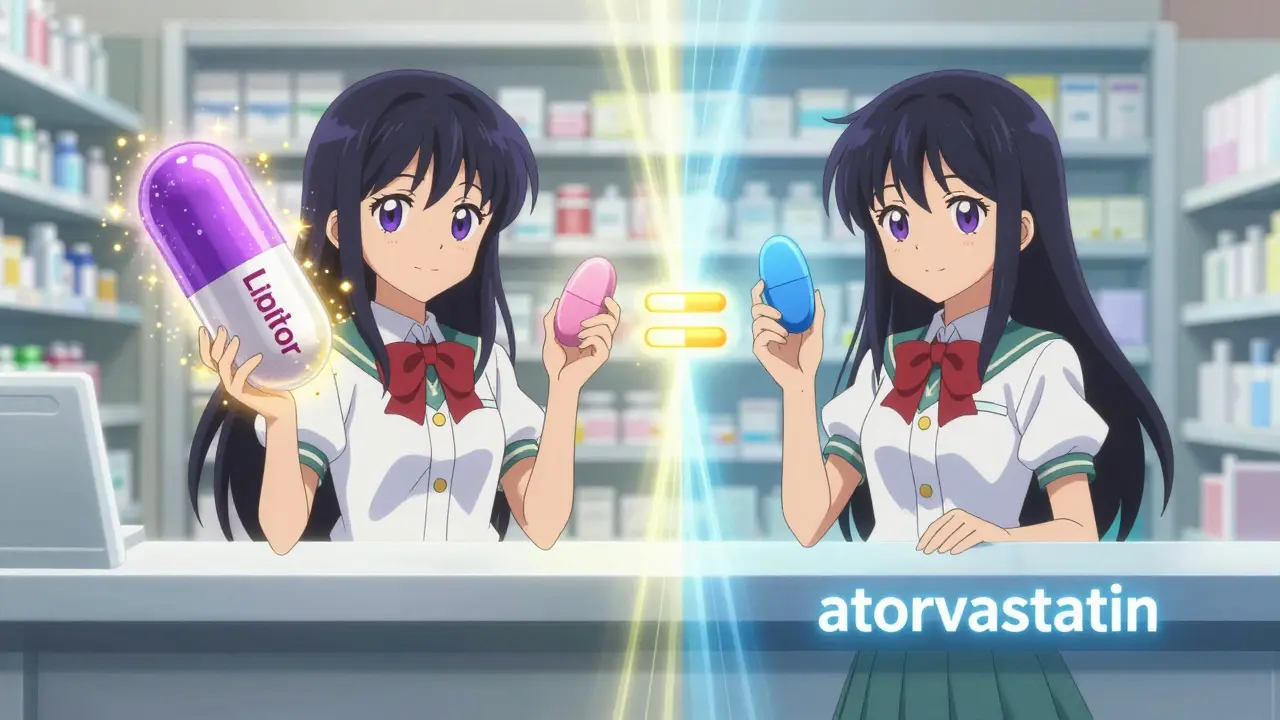
When you pick up a prescription, you might see two different pills on the counter: one with a familiar brand name like Lipitor, and another with a plain label saying atorvastatin. You might wonder - is this cheaper version just as good? The short answer is yes, for most people, and here’s why.
Same Active Ingredient, Different Look
Generic drugs aren’t knockoffs. They’re not inferior copies. They’re exact matches in what matters most: the active ingredient. The FDA requires that a generic drug contain the same active pharmaceutical ingredient (API) as the brand-name version, in the same strength, dosage form, and route of administration. That means if you’re taking 20 mg of omeprazole for acid reflux, whether it’s labeled Prilosec or omeprazole, the molecule doing the work is identical.
What changes? Everything else. The color, shape, size, and even the little imprint on the pill are different. Why? Because U.S. trademark law says a generic can’t look exactly like the brand-name drug. It’s not about safety - it’s about legal protection for the original maker. So your generic omeprazole might be a blue oval, while Prilosec is a purple capsule. That doesn’t mean it works differently. It just means your pill looks different.
Labeling: What’s Written on the Box
The label on a generic drug doesn’t lie. It doesn’t hide anything. The FDA mandates that generic drug labeling - including uses, warnings, side effects, and dosing instructions - must match the brand-name drug exactly. If the brand-name label says "may cause dizziness," so does the generic. If it warns against use during pregnancy, the generic carries the same warning.
The only real difference in labeling is the name. Brand-name drugs use proprietary names (like Advil or Claritin), while generics use the generic name (ibuprofen, loratadine). This isn’t a trick. It’s transparency. You’re seeing the chemical name, not the marketing name.
Therapeutic Equivalence: What the FDA Really Requires
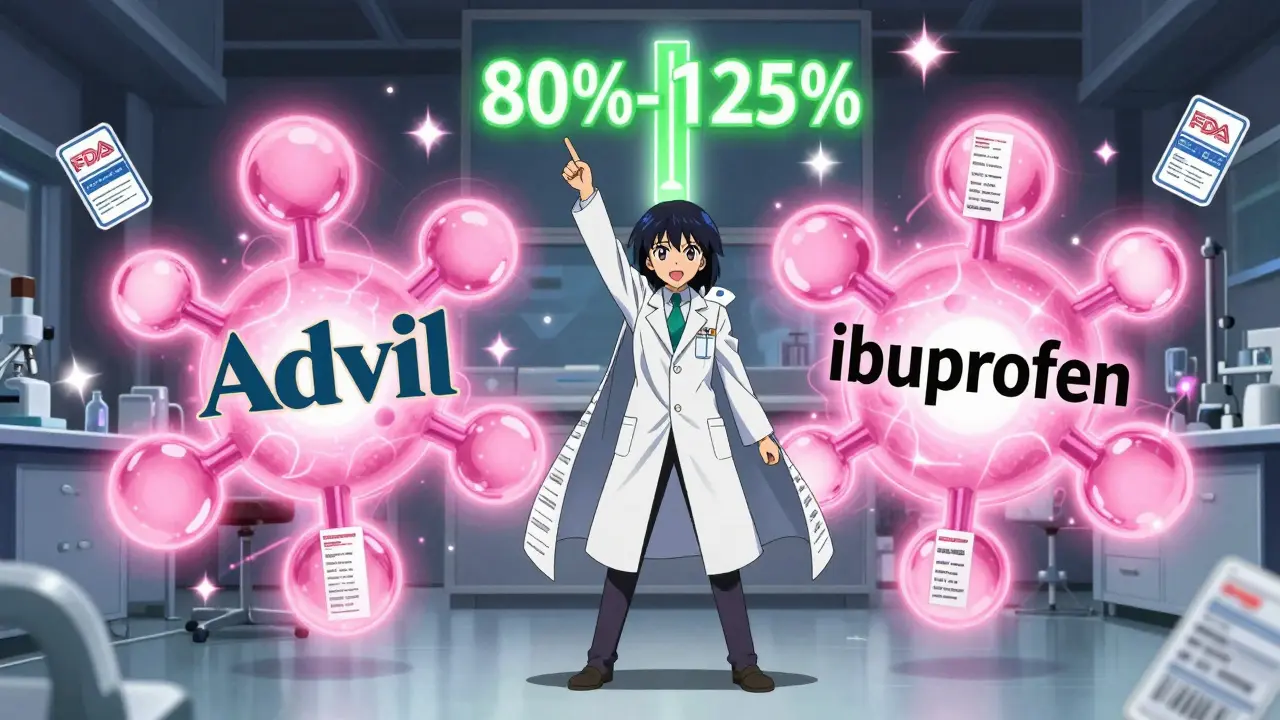
The biggest myth about generics is that they’re "close enough" - not quite the same. The FDA doesn’t allow "close enough." It demands proof. Every generic drug must pass a bioequivalence test. This means scientists measure how fast and how much of the drug enters your bloodstream compared to the brand-name version.
The standard? The generic’s absorption rate must fall within 80% to 125% of the brand-name drug. That’s not a wide gap - it’s tighter than the natural variation you’d see between two different batches of the same brand-name drug. In fact, studies show that the body’s own response to the same brand-name drug can vary more than the difference between brand and generic.
These tests are done on 24 to 36 healthy volunteers. The data is reviewed by the FDA before approval. And once approved, the drug is monitored through the FDA’s Adverse Event Reporting System (FAERS). If a generic started causing unexpected side effects, the FDA would know - and act.
Cost: The Real Difference
If the drugs are the same, why does one cost 10 times less? The answer is simple: competition. Brand-name drugs have patents. During that time, only one company can make it. Once the patent expires, dozens of companies can apply to make the generic. That drives prices down.
As of 2023, generics make up 90% of all prescriptions filled in the U.S. - but only 25% of total drug spending. Atorvastatin (Lipitor) used to cost $375 a month. Today, the generic version costs $4 at Walmart. That’s not a discount. That’s a revolution in access.
The Congressional Budget Office found that from 2007 to 2016, generics saved the U.S. healthcare system $1.67 trillion. In 2023 alone, they saved $313 billion. That’s money kept in people’s pockets and out of insurance premiums.
When Generics Aren’t the Same - The Exceptions
There are exceptions. Not because generics are flawed, but because some drugs are extremely sensitive. These are called narrow therapeutic index (NTI) drugs. A tiny change in blood level can mean the drug doesn’t work - or becomes dangerous.
The FDA specifically flags three: warfarin (a blood thinner), levothyroxine (for hypothyroidism), and phenytoin (for seizures). For these, doctors sometimes prefer to stick with one brand or generic. But even here, switching between generics is often safe - as long as you’re monitored. A pharmacist might check your blood levels after switching, just to be sure.
Another area where generics are harder to make: complex drugs like insulins, biologics, and drug-device combos (like EpiPens). These aren’t simple pills. They’re intricate systems. That’s why there are fewer generic versions - not because they’re unsafe, but because they’re harder to copy. The FDA is working on speeding up approval for these complex generics, with 79 approved in 2022 alone.
What Patients Really Say
On Drugs.com, generic atorvastatin has a 6.6 out of 10 rating from over 1,800 reviews. The brand-name Lipitor? 6.3. That’s not a difference. That’s noise.
On Reddit, pharmacists share stories: "I’ve switched thousands of patients. Zero issues - except with levothyroxine, where we checked TSH levels." That’s not a warning. That’s good practice.
A Kaiser Permanente survey found that 78% of people said generic cost savings helped them take their meds consistently. That’s huge. Skipping pills because they’re too expensive is a real problem. Generics fix that.
Some people feel uneasy when their pill changes color. One University of Michigan study found 12% of patients hesitated when they got a new-looking pill. But no study has shown that changing the pill’s appearance leads to worse outcomes. It’s a psychological bump, not a medical one.
What You Should Do
- Ask your pharmacist if a generic is available. Most of the time, it is.
- Check the FDA’s Orange Book. Look for "A" ratings - that means therapeutically equivalent.
- If you’re on warfarin, levothyroxine, or phenytoin, ask your doctor if you should stick with one version.
- Don’t assume a higher price means better quality. A $4 generic isn’t a bargain - it’s the standard.
- If you notice a change in how you feel after switching, tell your doctor. But don’t assume it’s the drug. It might be stress, sleep, diet - or just your body adjusting.
What’s Next?
The FDA launched its Generic Drug Program Dashboard in 2023 - a real-time tracker showing how many generic applications are pending. In 2024, they approved the first generic version of semaglutide (Ozempic). That’s a game-changer. Semaglutide cost over $1,000 a month. The generic could bring it down to under $100.
By 2028, over $268 billion in brand-name drug sales will face generic competition. More drugs will become affordable. More people will be able to take them.
Generics aren’t a compromise. They’re the rule. The FDA didn’t create this system to save money - it created it so everyone, no matter their income, can get the medicine they need.




Sherman Lee
February 3, 2026 at 17:00
lol so now we're supposed to trust a government agency that can't even fix the postal service? 🤡 I've seen generics that look like they were made in a garage. One time my 'atorvastatin' had a weird chalky taste. I spit it out. Coincidence? Maybe. Or maybe the FDA's "80-125%" range is just a fancy way of saying "eh, close enough." 🤷♂️