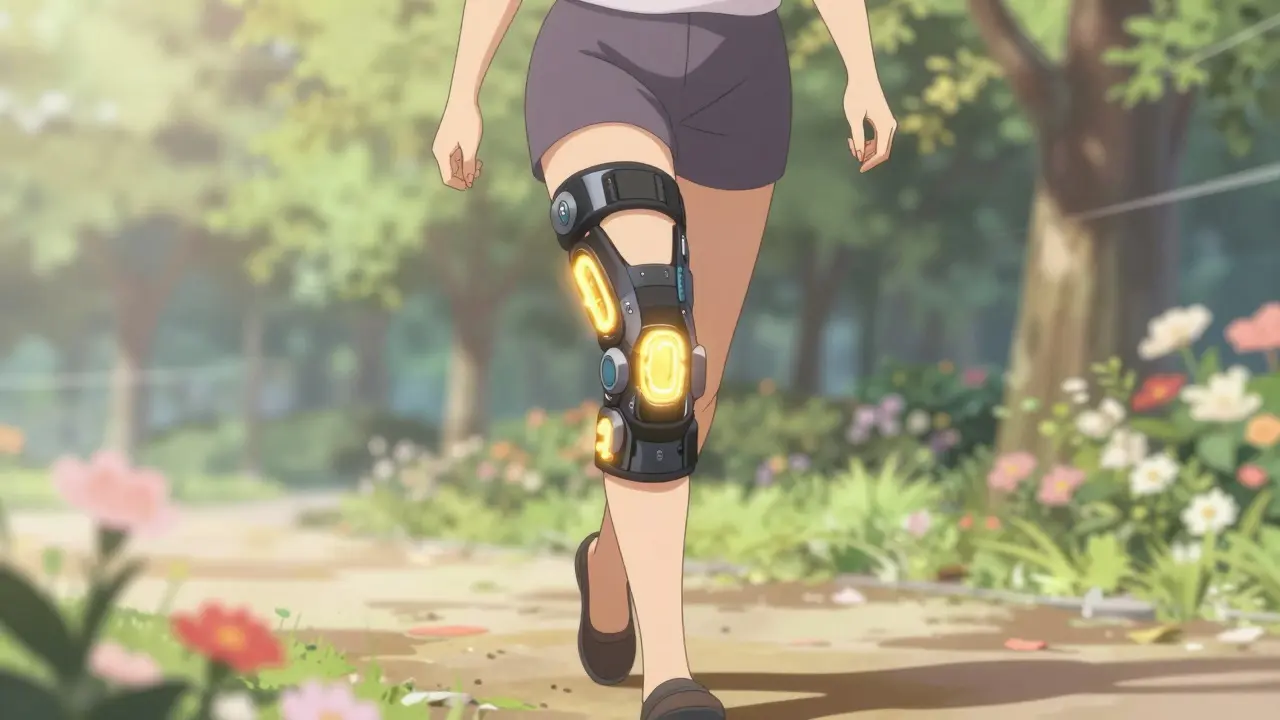
When your knee hurts just to stand up, you’re not alone
Over 250 million people worldwide live with knee osteoarthritis. It’s not just aging - it’s cartilage wearing down, bones grinding, inflammation flaring. The pain isn’t just in the joint; it spreads to your walk, your sleep, your mood. You’ve probably tried painkillers, but they don’t fix the root problem. And surgery? Too big a step for now. That’s where knee osteoarthritis pain management without surgery comes in - specifically, bracing, injections, and exercise. These aren’t magic fixes, but they’re the most proven ways to get you moving again without cutting into your knee.
Bracing: The Silent Support That Changes How You Move
Not all knee braces are the same. If you have osteoarthritis on the inner side of your knee - which 85% of people do - an unloader brace is what you need. It doesn’t just hold your knee still; it shifts your weight off the damaged part. Think of it like putting a wedge under a wobbly table. Studies show these braces cut pain by 30-45% on the WOMAC scale, one of the most trusted measures in arthritis research. People report being able to walk farther, climb stairs without grabbing the railing, even play with their grandkids again.
But here’s the catch: it has to fit right. A brace bought off Amazon or a drugstore shelf won’t cut it. You need a certified orthotist to measure your leg, adjust the straps, and make sure it’s not pinching your skin or slipping down. Most people need 2-3 weeks to get used to wearing it all day. And yes, they’re bulky. But 82% of 5-star Amazon reviews say the pain relief is immediate. The downside? Skin irritation, especially if you sweat a lot. Insurance often covers 80% of the cost, but you’ll pay a $203 deductible under Medicare in 2023. If you’re active, it’s worth it.
Injections: Fast Relief, But Not Forever
If your knee is screaming after a bad day, injections can be a reset button. There are three main types: corticosteroids, hyaluronic acid, and PRP. Corticosteroids are the quickest. A single shot costs $50-$150 and can knock out pain for 4 to 12 weeks. That’s why 38% of knee OA patients have tried them. But repeated use? That’s risky. Each shot carries a 0.1-0.7% chance of infection, and over time, steroids can damage the cartilage you’re trying to protect. The FDA recommends no more than 3-4 shots a year.
Hyaluronic acid is like adding fresh lubricant to a rusty hinge. It’s a gel injected weekly for 3-5 weeks, costing $500-$1,200 total. Newer versions like Gel-Syn 3 now last up to 22 weeks. But here’s the truth: it doesn’t work for everyone. Studies show it reduces pain by about 35mm on a 100mm scale - better than placebo, but not as strong as exercise over time. PRP, which uses your own blood platelets, costs $500-$2,000 and shows promise, but insurance rarely covers it. And botulinum toxin? Still experimental. Patients on Healthgrades give corticosteroid injections a 3.8/5 rating - 65% are satisfied, but 32% say the pain comes back worse than before. Injections are a temporary fix. They’re not a replacement for movement.

Exercise: The Only Treatment That Gets Better Over Time
This is where most people give up - and where the real win is. Exercise doesn’t just ease pain. It rebuilds your knee’s support system. Muscles around the joint, especially the quads and hamstrings, act like shock absorbers. When they’re weak, your knee takes all the stress. Water-based exercise - like walking in a pool - reduces joint load by 60%. One study found it cut pain by 28.7% on the VAS scale, compared to 22.3% for land-based workouts. Both require 2-3 sessions a week, 45-60 minutes each. You don’t need a gym. Just a pool, a chair, and consistency.
Land-based exercises? Focus on low-impact moves: seated leg extensions, heel slides, straight leg raises. A 2023 meta-analysis showed these improve total knee range of motion by an average of 8.2 degrees after 6-8 weeks of daily stretching. That might not sound like much, but it means you can bend your knee enough to sit in a car or get out of a chair without help. The real kicker? Long-term results. After 12 months, people who stuck with exercise saw a 32.5% improvement in function. Injections? Only 18.7%. And unlike braces or shots, exercise helps your hips, back, and ankles too. The catch? Adherence. Only 48% of people keep up with exercise after a year. That’s why starting with a physical therapist for the first 4-6 weeks makes all the difference. They’ll teach you how to do it right, so you don’t hurt yourself trying to help yourself.
What Works Best Together
The smartest approach isn’t picking one. It’s stacking them. Dr. Tuhina Neogi, a leading arthritis researcher, says the best strategy is “exercise plus bracing plus periodic injections for flare-ups.” Here’s how it looks in real life: Wear your unloader brace when you’re out walking or running errands. Do your daily stretches and pool workouts every morning. When your knee flares up after a long day, get a corticosteroid shot - but only once or twice a year. Don’t use injections as your main tool. Use them as a pause button, not a solution.
Bracing gives you immediate stability. Exercise builds long-term strength. Injections give you breathing room during bad patches. Together, they’re more effective than any single option. A 2023 network meta-analysis ranked bracing #1 for pain and function, but hydrotherapy topped the list for overall WOMAC score. That’s the sweet spot: brace during activity, exercise daily, inject only when needed.

Why Most People Fail - And How to Avoid It
People don’t fail because the treatments don’t work. They fail because they expect instant results. Braces feel awkward at first. Exercise is boring. Injections hurt. And insurance won’t always pay. Here’s how to beat the odds:
- For bracing: Wear it every day for 2 weeks before judging. Skin irritation? Try a moisture-wicking sleeve underneath. If it’s too bulky, ask your orthotist about a newer, slimmer model like Össur’s Unloader One Pulse.
- For exercise: Start with water. It’s easier. Use a chair for support. Do 10 minutes a day - not an hour. Build up slowly. Track your progress in a notebook: “Today I bent my knee 5 degrees farther.” That’s motivation.
- For injections: Don’t get them more than twice a year. If you’re getting them monthly, you’re avoiding movement. That’s a trap. Talk to your doctor about a plan that ties injections to activity goals, not just pain levels.
And remember: 73% of people stick with exercise for 3 months. Only 48% make it to 12. You don’t have to be perfect. Just consistent. Even 20 minutes a day, 3 times a week, makes a measurable difference.
What’s Changing Right Now
The field is evolving fast. Smart braces with built-in sensors now track your gait and give real-time feedback - like a coach in your knee. New hyaluronic acid formulas last longer. And health systems are starting to bundle all three treatments into one program. Medicare and private insurers are slowly catching up, but coverage is still messy. If you’re told an injection isn’t covered, ask for a prior authorization. Sometimes, just asking works.
Looking ahead, doctors will match you to your best treatment based on your biomechanics - not guesswork. In 5 years, you might get a scan, wear a sensor for a week, and get a personalized plan: “You need a brace with 15 degrees of offloading, 3x weekly water aerobics, and avoid injections unless pain hits 7/10.” That’s the future. But today, you don’t need to wait. You can start now.
Bottom Line: Pick Your Path - But Don’t Pick Just One
Knee osteoarthritis pain doesn’t have to mean giving up. Bracing gives you immediate support. Injections give you quick relief. Exercise gives you lasting freedom. The best outcome? Using all three - not as separate options, but as a team. You don’t need surgery. You don’t need to suffer. You just need to move, support, and reset - the right way, at the right time.







Nick Cole
January 17, 2026 at 18:49
I've been using an unloader brace for 8 months now. It felt like a prison at first-tight, hot, awkward-but after two weeks, I forgot I was wearing it. The real game-changer? Walking my dog without wincing. I used to dread the morning routine. Now? He drags me out, and I actually look forward to it. No magic, just mechanics.