Steroid-Induced Cataract Symptom Checker
This tool helps you determine if your vision changes might be caused by steroid-induced cataracts. Select all symptoms you're experiencing.
Symptoms Checklist
What Are Steroid-Induced Cataracts?
When you take steroids-whether as eye drops, inhalers, pills, or injections-you’re fighting inflammation. That’s good. But your eyes might pay a hidden price. Steroid-induced cataracts are a known side effect of long-term corticosteroid use, and they don’t wait years to show up like age-related cataracts. They can appear in as little as 2 to 4 weeks, especially if you’re on high doses or using topical steroids in your eyes.
Unlike the slow, cloudy lens changes from aging, steroid-induced cataracts form at the back of the lens, right where light enters. This is called a posterior subcapsular cataract (PSC). Even a tiny spot of cloudiness here can make your vision blurry, glare-heavy, and hard to manage at night. It’s not just about aging-it’s about chemistry. Steroids react with proteins in your lens, forming stubborn clumps that scatter light. Your lens can’t repair itself, so once the damage starts, it builds up.
How Do You Know If It’s Happening to You?
If you’re on steroids and notice these changes, don’t ignore them:
- Blurry vision-especially when reading or doing close work
- Halos around lights-car headlights or streetlamps at night look like glowing rings
- Faded colors-red looks dull, white looks yellowish
- Double vision in one eye-not both eyes, just one
- Difficulty seeing in low light-you used to drive at night fine, now you avoid it
- Glare sensitivity-sunlight or bright indoor lights feel painful or overwhelming
These symptoms hit fast. One month you’re fine. The next, you’re squinting to read your phone. That’s not normal aging. That’s your lens reacting to steroids. Studies show 83% of patients report glare issues, and 76% struggle with night vision. If you’re on steroids and suddenly can’t see clearly up close or in dim light, it’s time to get your eyes checked.
Who’s Most at Risk?
It’s not just about taking steroids-it’s how much, how long, and how you take them.
- Topical eye drops carry the highest risk-3.2 times more likely to cause cataracts than oral steroids, according to a 2024 study from Saudi Arabia.
- Long-term use-4 months or more of any steroid form (inhaled, injected, oral, or eye drops) raises your risk significantly.
- High doses-patients on more than 2,000mg of beclomethasone (a common inhaled steroid) show much higher rates of cataracts.
- Children-long-term steroid treatment in kids is strongly linked to both cataracts and increased eye pressure.
- Existing eye conditions-if you already have diabetes, uveitis, or an artificial lens (IOL), your risk doubles.
Even if you think you’re safe because you’re using an inhaler for asthma, you’re not. Steroids in your lungs can still reach your eyes through your bloodstream. And if you’ve been on steroid eye drops for dry eyes or allergies for months, you’re in the danger zone.
How Do Doctors Spot It Early?
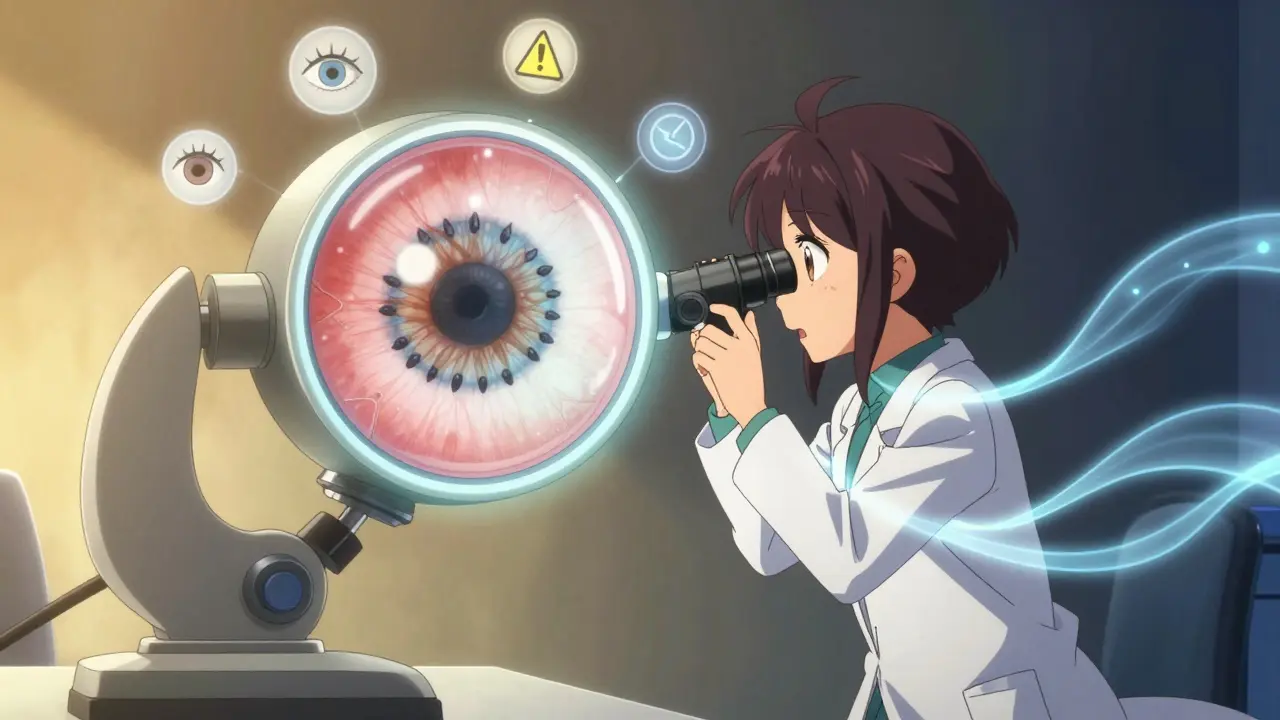
Regular eye exams aren’t optional if you’re on long-term steroids. The American Academy of Ophthalmology recommends a baseline eye exam before you start, then checkups every 3 to 6 months. But here’s the catch: early steroid-induced cataracts don’t always cause symptoms. That’s why specialists use a tool called a slit-lamp biomicroscope-it’s like a high-powered microscope for your eye. It can see tiny clouding at the back of the lens before you even notice blurry vision.
Many patients don’t realize their vision is changing until it’s advanced. Ophthalmology residents need 6 to 12 months of training to reliably spot early signs. That’s why it’s so important to go to an eye doctor who knows what to look for-not just a routine vision test at the optometrist. You need a full dilated exam with a specialist who understands steroid complications.
Can You Reverse It Without Surgery?
Once the protein clumps form in your lens, they don’t go away. No eye drops, no supplements, no diet change can clear them. The only proven fix is surgery.
But here’s where it gets tricky: if you need steroids to control asthma, lupus, rheumatoid arthritis, or another serious condition, stopping them isn’t always an option. The goal isn’t to stop steroids-it’s to manage the damage. Your doctor might try to reduce the dose, switch to a less potent steroid, or switch from eye drops to a different treatment. But if your vision is already failing, waiting isn’t safe.
Some research is looking into antioxidants like vitamin C or E to protect the lens, but nothing’s proven yet. Don’t waste time on unproven remedies. The truth is, if steroid-induced cataracts are affecting your daily life, surgery is the only reliable solution.
What Does Cataract Surgery Involve?
Cataract surgery is one of the most common and safest operations in the world. In the U.S., over 3.8 million are done every year. For steroid-induced cataracts, the process is the same:
- Your cloudy natural lens is removed using ultrasound.
- A clear artificial lens (IOL) is inserted to replace it.
- You go home the same day.
Recovery takes a few weeks. You’ll use eye drops to prevent infection and swelling. Most people see better within a day or two. Studies show 92% of patients get major vision improvements after surgery.
But there’s a catch: if you keep using steroids after surgery, your new lens can still develop clouding around the edges-called posterior capsule opacification. It’s not a new cataract, but it can blur your vision again. That’s why your eye doctor will monitor you closely after surgery, even if you’re still on steroids. A quick laser procedure can fix it if it happens.
What Happens If You Don’t Treat It?
Left alone, steroid-induced cataracts will keep getting worse. Your vision won’t just blur-it’ll distort. Colors fade. Night driving becomes dangerous. Reading becomes impossible. You might start avoiding social events because you can’t see faces clearly. And if you’re also dealing with steroid-induced glaucoma (another common side effect), you could lose peripheral vision permanently.
Worse, the longer you wait, the harder surgery becomes. Advanced cataracts are denser, more brittle, and harder to remove. That means longer surgery, higher risk of complications, and slower recovery. You don’t have to wait until you’re nearly blind to act.
How to Protect Your Vision
You can’t always stop steroids-but you can protect your eyes:
- Get regular eye exams-every 3 to 6 months if you’re on long-term steroids.
- Use the lowest effective dose-ask your doctor if you can reduce your steroid use over time.
- Switch delivery methods-if you’re on eye drops, ask if a different treatment (like immunomodulators) could work instead.
- Know the signs-if your vision changes, don’t wait. Book an eye exam immediately.
- Coordinate care-make sure your primary doctor and eye doctor talk to each other. Studies show coordinated care reduces vision loss by 37%.
Most people think cataracts are just part of getting older. They’re not. If you’re on steroids, your eyes are on the front lines. Ignoring early signs isn’t patience-it’s risking your vision.
Final Thoughts
Steroid-induced cataracts are preventable if you act early. They’re treatable if you act before they ruin your life. You don’t have to choose between controlling your illness and keeping your sight. With the right monitoring, the right doctor, and the right timing, you can do both.
Don’t wait for your vision to fail. If you’re on steroids and your eyes feel off, get checked. It’s not paranoia-it’s protection.




Sue Stone
January 22, 2026 at 15:04
I’ve been on steroid eye drops for dry eyes for 6 months and just noticed how much glare I get at night. Thought it was just old screen glare. Turns out it’s my lens. Scary how fast it happens.